


Gaza’s Board of Peace Announces Historic Agreement for Complete Disarmament of Hamas and Other Armed Groups
The Gaza Board of Peace, a coalition of international mediators led by Egypt, Qatar, Turkey, and the United States, has announced an agreement aimed at fully ending Israel’s military presence in Gaza. The deal, which was finalized on Thursday after months of negotiations, marks a significant step towards achieving lasting peace and security for the region.
Under the agreement, Hamas is expected to disarm its armed groups, including rocket launchers, tanks, and other heavy weaponry, over several stages. According to the plan, Israel must withdraw its forces from Gaza in phases, with the first phase involving a gradual withdrawal of troops and military equipment.
The agreement was announced by US President Donald Trump on Truth Social late on Thursday, after the Board of Peace had finalized a roadmap for this next phase of the ceasefire. The mediation process involved Egyptian, Qatari, Turkish, and US officials who worked closely with Hamas to ensure compliance.
Hamas has agreed to implement the disarmament agreement in stages, with Israel fulfilling its obligations under the plan before any further steps can be taken. However, Hamas’s implementation will depend on Israeli forces meeting their commitments, as stated by Ghazi Hamad, a member of Hamas’s negotiating delegation.
The process includes an inventory of Hamas’s weapons within 14 days, followed by extensions if agreed upon by international verification commissions and all parties involved. A Palestinian National Committee will oversee the disarmament process and ensure that no weapons are transferred to Israel or any other non-Palestinian party.
An international verification commission, led by the US, Qatar, Turkey, and Egypt, will monitor the disarmament efforts as Israeli troops withdraw from designated lines in step with verification progress. The inventory and storage of Hamas’s weapons will initially target heavy weaponry, military production sites, and the extensive tunnel network.
The process is contingent on several steps, including the entry of the National Committee (the Palestinian factions) and the deployment of the international force. Disarmament phases will be directly tied to Israel’s gradual withdrawal from areas controlled by Hamas and a broader implementation of the peace plan.
While the agreement has been met with both hope and skepticism, it marks an important step towards achieving lasting peace in Gaza. The success of this process will depend on the commitment of all parties involved, including Hamas, Israel, Egypt, Qatar, Turkey, and the US.
The announcement comes against a backdrop of deep Palestinian distrust of Israel due to its failure to adhere to previous agreements. Since the ceasefire supposedly came into effect on October 10, 2025, Israeli attacks have killed at least 1,100 Palestinians, while Israel has continued to restrict humanitarian aid from entering Gaza and expanded its “Yellow Line” further into the Strip.
As the process unfolds, it remains to be seen whether all Palestinian armed groups apart from Hamas will adhere to the agreement. Questions also surround whether Israeli forces would fully withdraw from Gaza under the terms of the deal.
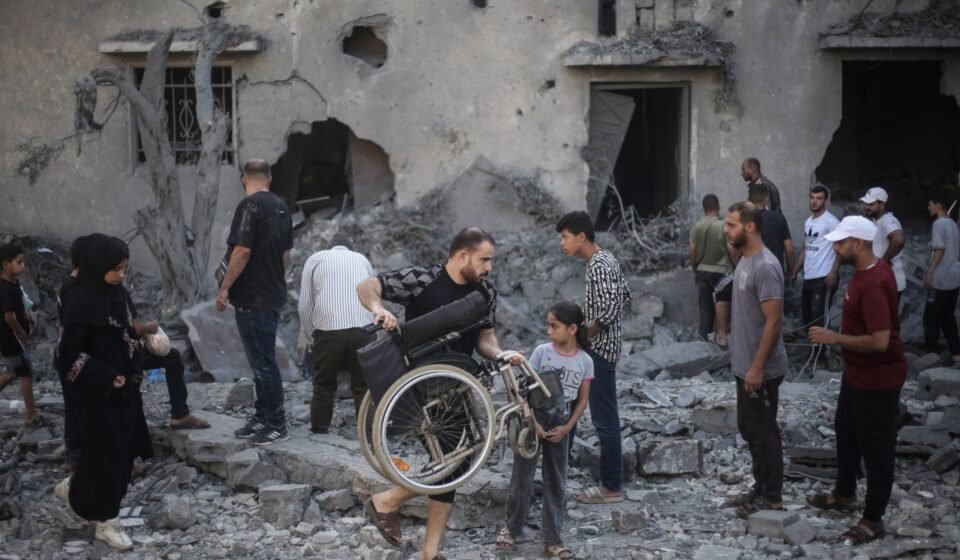
The success of this initiative is not without its challenges. The ongoing conflict in Gaza has led to repeated displacement and severe shortages of food, medicine, and shelter for Palestinians. The international community’s efforts to broker a lasting peace have been hindered by Israel’s refusal to comply with previous agreements.
In conclusion, the announcement marks an important step towards achieving lasting peace in Gaza. While there are still many questions surrounding the agreement, it is clear that this process represents a significant shift towards a more peaceful and stable future for the region.
Source: Al Jazeera
Based on reporting from Al Jazeera.