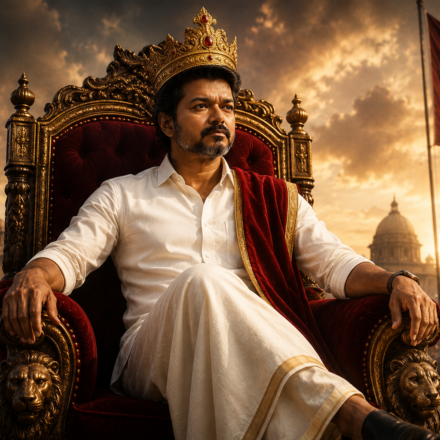
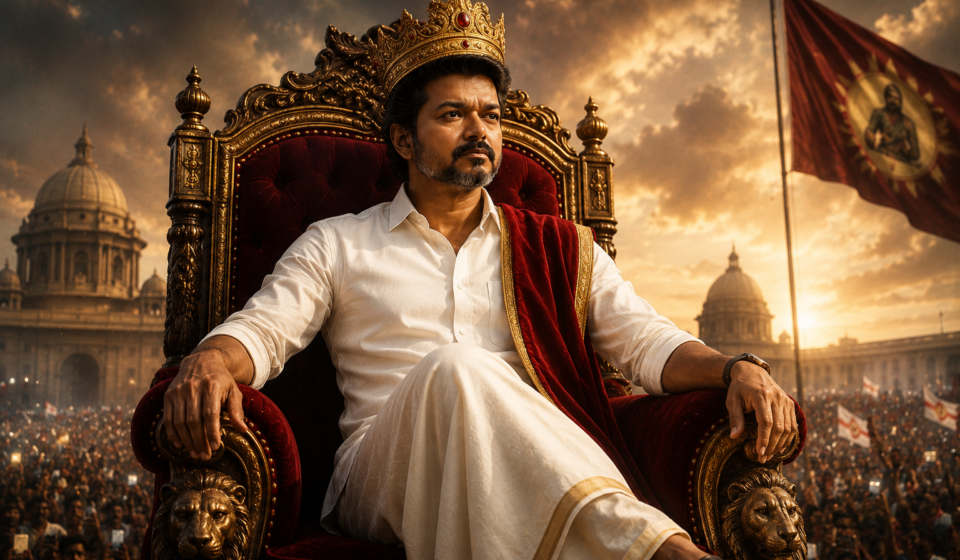

Thalapathy Vijay (C. Joseph Vijay), the Tamil actor-turned-politician and current Chief Minister of Tamil Nadu, ranked third in a recent national opinion survey for the preferred next Prime Minister of India. This comes from the latest India Today–C Voter Mood of the Nation survey, conducted between July 1 and August 25, among 25,000 respondents.
- Narendra Modi: 48.7%
- Rahul Gandhi: 27.1%
- Joseph Vijay (Thalapathy Vijay): 9.2%
This survey was quite interesting, not because they ranked Modi first despite the ongoing conflicts and controversies, but because what made it a mainstream discussion was the name of Thalapathy Vijay. He became the first-ever Tamil Nadu CM to be in the national discussion for the PM’s office.
There are a lot of questions that have been raised:
Is this a PR survey or a national voice?
How did he manage to be on the list?
Is the next election going to be Modi vs. Vijay?
Is this a PR survey or a national voice?
Over social media, many users believe it to be a biased survey, referring to the Bharatiya Janata Party being ranked first. While, in the case of Vijay, there has been a rapid growth following his decisions in his earlier career. Agencies like India Today, C Voter, and the Mood of the Nation have built credibility. From the point of view of the Indian community, these surveys are recognised and valued.
Somehow, his film industry fame, followed by Thalapathy’s work in earlier ruling days, boosted his popularity in other states, as they already knew Vijay for his stardom. His fanbase and social media fan accounts have helped him, even though he has left the film industry. His political speeches and public interactions have gone viral on social media. One of his speech styles became so famous that it now symbolises his iconic style.
How did he manage to be on the list?
Thalapathy started his work from day one, where he doubled free electricity up to 200 units, which was previously 100 units. Following this, he also created Singapenn, a special task force for women’s safety and rapid action against crimes against women. He also created 65 special anti-narcotics units to tackle drugs statewide.
He took serious action against liquor outlets near schools, colleges, places of worship, and bus stands. As a result, 717 TASMAC outlets were closed, and many were limited to a specific radius. He took action for relief for farmers, where a waiver of up to 75,000, with additional partial relief of a higher amount, benefited over 14 lakh farmers, with spending of up to 6,000 to 6,220 crores.
He raised incentives for paddy and sugarcane. Meanwhile, the increase in the Aavin milk price from 38 to 41 benefited milk producers. The list is long, with a 1-gram gold ring for newborns in government hospitals, 8-gram gold coins and silk sarees for eligible brides, the breakfast scheme for students being extended, laptops for college students, branded bicycles for Class 11 students, and health insurance increasing from 5 lakhs to 25 lakhs. Meanwhile, in a recent announcement, he promised LPG cylinders for 1.3 crore families.
Within his 100 days in office, he has already done so much practical work, and a lot more is in progress. Governance, transparency, and economic promises are listed, with 1 lakh crore+ in commitments through investment conclaves and multiple MoUs.
Is the next election going to be Modi vs. Vijay?
Technically, that is not possible yet. The BJP is trying to bring Modi for his consecutive fourth tenure as PM. But, by the frequency of Vijay’s popularity growth, it is expected that Vijay will be the third-most-popular leader in India, with 12–18%. He got 9% in just 100 days, which was promising, but to become the second-most-popular leader, he would have to overcome a gap of 18% with Rahul Gandhi. That is technically not possible until the election after 2028–29.
Vijay will appear as a power force in the South. An alliance between Vijay and Rahul Gandhi could be a hard-fought challenge for Modi to retain his office. But for that, there are still two years. Until then, how the political landscape shapes up will be interesting to predict.