

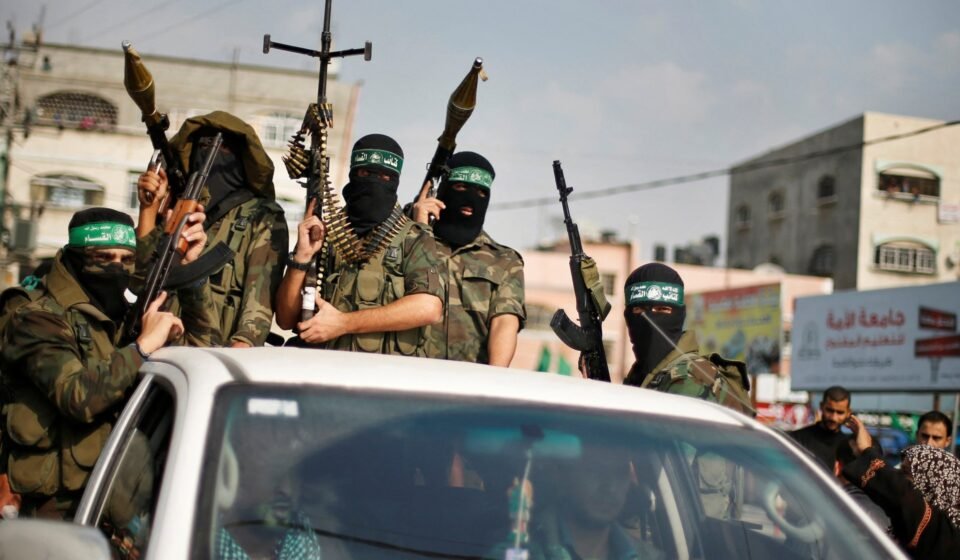

Hamas Signs Historic Disarmament Agreement Amidst Concerns Over Implementation
In a significant development for the Middle East peace process, Palestinian group Hamas has announced that it has agreed to a deal aimed at fully ending Israel’s war on Gaza. The agreement, which was confirmed by the United States and other mediators, requires Hamas to make provisions to disarm and surrender its weapons in stages.
The deal marks a major breakthrough in the ongoing efforts to bring an end to the 11-year conflict between Israelis and Palestinians. After years of failed ceasefires and violence, the international community has been working tirelessly to facilitate a peaceful resolution.
According to sources close to the negotiations, Hamas has agreed to disarm its military forces and surrender most of its arsenal, with the entry of the National Committee for the Administration of Gaza (NCAG) being seen as a crucial condition. The NCAG is expected to oversee the dismantling of Israeli-backed militias in Gaza and ensure that all arms are removed from the territory.
The agreement was announced by President Donald Trump on Thursday, after the US-led Board of Peace and International Stabilization Force for Gaza announced that mediators from Egypt, Qatar, Turkey, and the United States had finalised a roadmap for moving forward. The truce deal has been hailed as “historic” by many in the region.
However, concerns over the implementation of the agreement have already begun to surface. Former army chief of staff Gadi Eisenkot expressed his skepticism about Hamas’s commitment to disarmament, stating that Israel must not accept a reality where Hamas survives and rears its head again.
Hamas has insisted that disarmament will depend on Israel ending hostilities and pulling back from Gaza. The group stated that the entry of the NCAG was necessary to ensure that all conditions were met before proceeding with implementing the timeline for what had been agreed upon.
The framework also includes provisions for a full troop withdrawal, the deployment of international forces, and reconstruction efforts in Gaza. Hamas has welcomed the roadmap as “comprehensive” and said it made concessions for the sake of its Palestinian people.
Palestinian Islamic Jihad, another faction to the original ceasefire alongside Hamas, expressed skepticism about an agreement between the factions and Israel. The movement stated that reports of a deal were inaccurate and that they had reservations about it in its currently circulated form.
The National Committee for the Administration of Gaza welcomed the roadmap as “full readiness” to assume governance of the enclave and restore essential services. Board of Peace director general Nickolay Mladenov acknowledged how close the talks had come to collapse over recent months, stating that what happens next matters even more than the agreement itself.
Egypt, Qatar, and Turkey have also expressed support for the framework, with Egypt’s foreign minister saying that “the international community is committed to supporting a peaceful resolution” in the region. The three mediating states, alongside the US, brokered the framework amid intensive negotiations over several months.
The implementation of the agreement will be closely monitored by the international community and other stakeholders. Concerns remain about whether Hamas’s commitment to disarmament can be sustained, particularly given Israel’s continued military presence in Gaza.
As the world waits with bated breath for the next phase of the ceasefire, one thing is clear: a historic deal has been reached, but its success will depend on the ability of all parties involved to put aside their differences and work towards a lasting peace.
Based on reporting from Al Jazeera.