
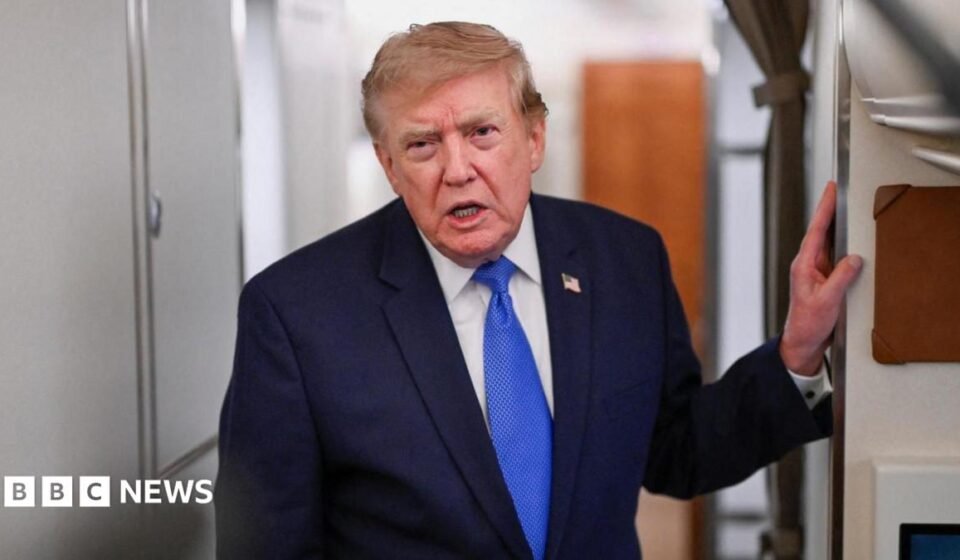

US President Donald Trump has announced that new talks with Iran will begin on Monday, following a call-off of what he described as “massive” strikes on the country. The move comes after Trump expressed frustration over what he said was an agreement between US and Iranian allies in the Middle East to hold off on further military action.
In a statement released on Sunday, Trump cited reports from Saudi Arabia’s Crown Prince Mohammed Bin Salman and other US partners that Iran had been seeking permission to proceed with strikes. He claimed that these requests were “nothing but a new lie” and stated that he was not looking to kill people in the talks.
Trump declined to outline a deadline for a deal to be struck, saying instead that “we’ll just see how it is.” The US president added that Saudi Arabia’s Crown Prince Mohammed Bin Salman had urged him against conducting strikes over the weekend. He also mentioned that there were deals on Hormuz and nuclear issues in place, which he claimed would lead to further talks.
Global oil prices fell on Monday morning in Asia trading after Trump’s announcement. Brent Crude oil was down by 4.5% at $83.98 (£62.26), while US-traded oil was 4.6% lower at $80.74 (£59.85). Energy prices have fluctuated since the conflict started on February 28 due to disruptions in shipping through the Strait of Hormuz.
Iran’s semi-official Mehr news agency denied that Tehran had asked the US to hold off on further military action, saying Trump’s claims were “nothing but a new lie.” On Sunday, Iranian Foreign Minister Abbas Araghchi stated that negotiations with Oman on a deal on the Strait of Hormuz were “on track for finalisation,” according to Iranian media.
The planned strikes would have been considered one of the largest attacks since World War II, Trump said. However, he declined to answer if he had been planning to strike Iran’s energy infrastructure, which international law experts have argued could constitute a war crime.
Iran’s acting Defence Minister Majid Ibn al-Reza stated that Tehran viewed every threat from its adversaries as “real and credible,” even if it formed part of psychological warfare. He added that the US would neither be caught off guard nor remain passive in response to threats.
The US president has previously issued apocalyptic warnings to Tehran, only to subsequently insist on diplomacy being given a chance. However, his administration’s approach to dealing with Iran has been widely criticized by some conservative strategists ahead of the November midterms.
In an earlier post on Truth Social, Trump had called off what he said would have been “massive” strikes on Iran. The US president declined to outline a deadline for a deal to be struck and stated that Saudi Arabia’s Crown Prince Mohammed Bin Salman urged him against conducting strikes over the weekend.
The planned talks are seen as a significant development in the ongoing conflict between the US and Iran, which began on February 28. The situation remains fluid, with no clear outcome or timeline for the negotiations.
Based on reporting from BBC Top Stories.