
Iran’s Pick axe Mountain: A Contested Nuclear Site
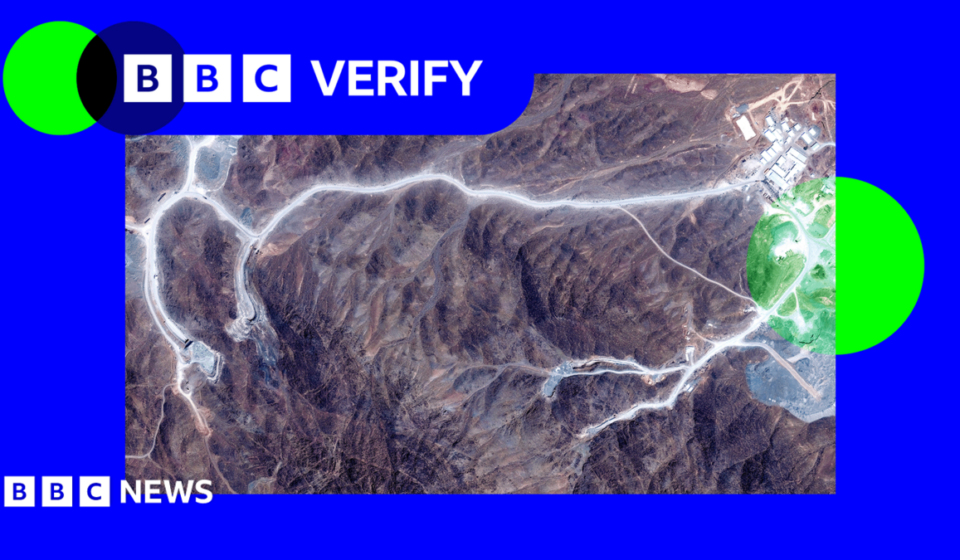
Located immediately south of Iran’s largest nuclear enrichment facility in Natanz, Kuh-e Kolang, also known as Pickaxe Mountain, has been shrouded in mystery and speculation for years. The site is believed to be the location of a suspected underground nuclear reactor or storage facility, with some experts suggesting it may have been built to replace an existing building within the Natanz complex.
The site’s exact purpose remains unclear, but its potential significance cannot be overstated. Iran has previously indicated that Pickaxe Mountain was intended as a replacement for a damaged building used in the assembly of advanced centrifuges at Natanz. However, former head of the Atomic Energy Organisation of Iran, Ali Akbar Salehi, stated in September 2020 that “a more modern, spacious, and comprehensive facility” would be built near Natanz.
Satellite images taken on June 30, 2026, show several construction vehicles near one of the western entrances to Pickaxe Mountain. This has led some experts to speculate that the site may have been chosen for its potential as a secure location to store highly enriched uranium or other sensitive materials.
The US-based Institute for Science and International Security (ISIS) analyzed satellite imagery taken on June 30, 2026, and concluded that external Iran had partially filled two of the eastern tunnels with concrete to block ground access. This has raised concerns about the potential security risks associated with Pickaxe Mountain.
Experts have also suggested that the site may be vulnerable to attack due to its depth and uncertain layout. The US GBU-57 bomb, a bunker-busting munition capable of penetrating 18m (60ft) of concrete or 61m (200ft) of earth before exploding, could potentially destroy Pickaxe Mountain.
However, even if the site is destroyed by an attack, it may not be entirely secure. Experts have suggested that targeting tunnel entrances, communications systems, access roads, and other supporting infrastructure could paralyse the facility’s operations, leaving it vulnerable to further attacks.
The International Atomic Energy Agency (IAEA) has so far been denied access to Pickaxe Mountain by Tehran, but Rafael Grossi, director-general of the IAEA, stated in March that Iran had “announced their intention to have nuclear activity there”. The IAEA estimated in 2025 that Iran holds roughly 440kg (970lbs) of 60% enriched uranium.
The potential significance of Pickaxe Mountain cannot be overstated. If confirmed as a storage facility for highly enriched uranium or other sensitive materials, it would pose a significant threat to global security and raise concerns about the proliferation of nuclear weapons.
Source: BBC Top Stories
Based on reporting from BBC Top Stories.