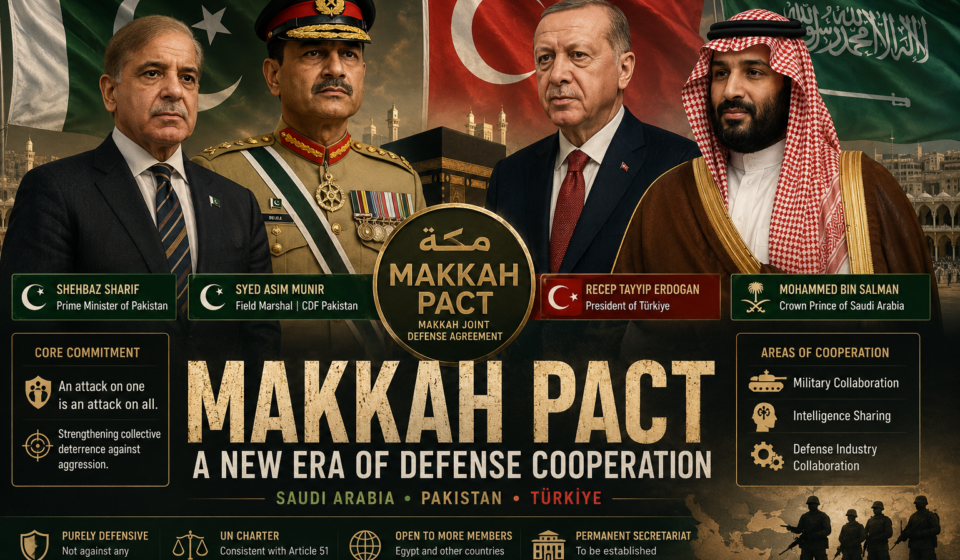

On August 7th, 2026, a high-profile meeting was held in Saudi Arabia, where Pakistan’s CDF and Field Marshal Syed Asim Munir, Prime Minister of Pakistan Shehbaz Sharif, Turkish President Recep Tayyip Erdogan, and Crown Prince of Saudi Arabia Mohammed bin Salman were present. At the end, this resulted in an agreement known as “The Makkah Pact” or “Makkah Joint Defense Agreement.”
A joint statement from the officials said the agreement is intended to strengthen collective deterrence against any act of aggression against any of the three. Its core commitment is that if any armed attack against one is considered an attack against all of them. It also provides for cooperation in the enhancement of defense in all aspects, including military, intelligence, and industrial collaboration. Officials claimed it to be purely defensive in nature, not targeting any specific country. This is consistent with the right of the United Nations to individual and collective defense under Article 51.
What is the Makkah Pact?
The Makkah Pact is a collective agreement in which all three countries will provide help to each other in the defensive zone. Saudi Arabia’s economic weight and geography, Turkey’s military capabilities and defense industry, and Pakistan’s military experience, plus its status as the only nuclear-armed Muslim state, make the collaboration of these three a fruitful pact for all of them.
The core point is that tackling any military attack on one unit will decrease tensions. Right now, Saudi Arabia is facing the Houthis, while Turkey has conflicts with Kurds, and somewhere, the concern of India for Pakistan is still active despite a massive slap in last year’s retaliation. Somehow, this agreement stops these hazards for all three of them.
Why is this raising concern in the global world?
Many media outlets reported this agreement as “Muslim NATO.” The statement of Vice Prime Minister of Pakistan Ishaq Dar also gave a sign. He stated that more countries can join as it is to do peace-making. Egypt can also join if they resolve a few things that are cornering it. Somehow, it was a similar kind of demonstration, but what neutralizes this point is the presence of CDF Asim Munir. The whole world knows how much CDF puts effort into the ceasefire between the US and Iran.
Where the global world has kept silent on this pact, Israeli officials are expressing their concern. It was labeled as a Sunni Muslim bloc:
- A senior Israeli official described the agreement as troubling and said it is “an alliance aimed against Israel,” while warning that Egypt could eventually join.
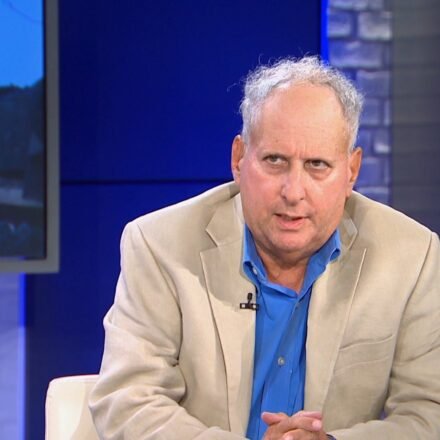
- Agriculture Minister Avi Dichter called it a “very, very problematic Sunni alliance,” highlighting Pakistan’s nuclear capability and the need for Israel to stay on guard.
- Israeli analysts and media have discussed complications for potential Saudi-Israel normalization, given Turkey and Pakistan’s positions, a possible strengthening of the “Sunni bloc,” and the need for Israel to deepen alternative partnerships, such as with Greece, Cyprus, India, and the UAE.
On the other side, many people are saying this is a pact against Iran. Where in the Middle East things are messed up, Saudi Arabia needs someone to guard them. Saudi Arabia already signed an agreement with Pakistan before, and with the addition of Turkey, this is more secure. Again, this thing does not hold, where Pakistan and its relationship with Iran is clear. Where Pakistan is a potential stakeholder to prevent a US-Iran war. During the Middle East conflict, Pakistan pushed the United Arab Emirates and other Arab nations to attack Iran. Additionally, despite Pakistan and Saudi Arabia’s agreement, CDF pushed Iran to avoid conflict and brought them to talks. Rather than simply attacking Iran to fulfill the agreement’s core, the presence of responsible leadership in Pakistan avoids the conflict from spreading.
Somewhere, the presence of Pakistan in the Makkah Pact makes things safer for the world. The ideal leadership of CDF Asim Munir always solves things through talks rather than conflict.
What is the future of it?
The future of this pact is potentially seen as the addition of many more countries. It was already signaled that Egypt will join soon, while reports suggested names from Gulf states such as Qatar and Kuwait, but they were not publicly included or announced. Right now, this is a path to get a possible advantage to improve their military capacity and industrial enhancement. It does not replace the bilateral or multilateral agreements, such as the one Pakistan had with Saudi Arabia inked in September 2025. There will be a permanent secretariat planned in Saudi Arabia.
This pact is still kept intact, as not much information is available. There are a few things revealed by Pakistani Vice Prime Minister and other officials. But the thing that is clear is that it will not be what it is believed to be: a “Muslim NATO.”